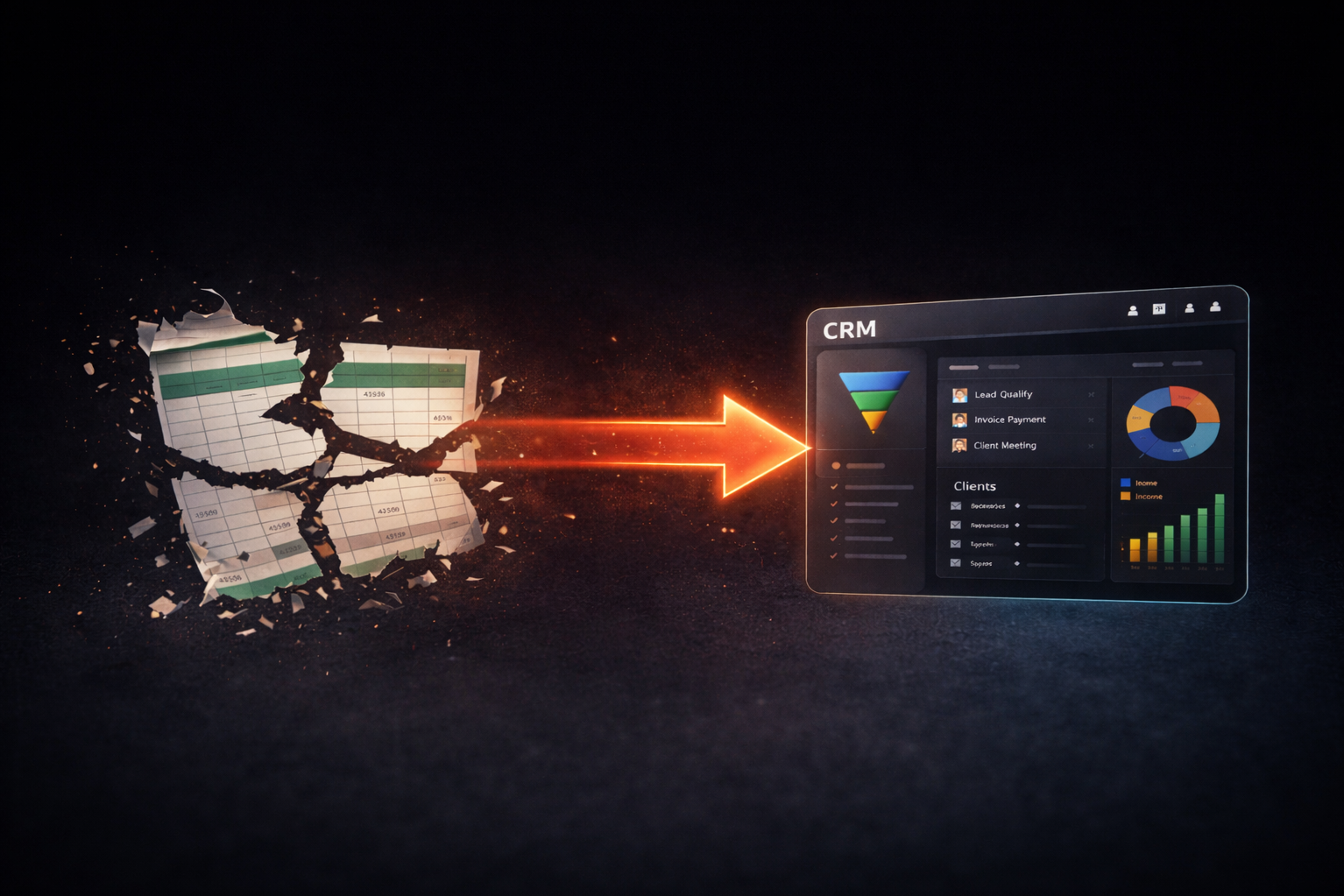
If Excel used to be a “universal solution” for small and medium-sized businesses, it is now increasingly becoming a source of problems. In Kazakhstan and across the CIS as a whole, a simple trend is gaining momentum: companies are massively moving away from spreadsheets, chats and scattered services to CRM/ERP and internal systems that bring processes together in one place. This is not about being “trendy” but about “surviving and growing”.
Why Excel has stopped coping right now
Excel has a strong side: it is fast, cheap and easy to understand. But it has a ceiling. As soon as a business starts to grow, spreadsheets turn into a “temporary solution for years” that gradually begins to break processes.
The breaking point usually comes the same way:
- more employees and roles appear;
- the flow of requests/clients grows;
- more money is in circulation;
- several sales channels appear (social media, website, calls, messengers, marketplaces);
- payments, installments, refunds, bonuses and subscriptions are introduced;
- the manager wants to see the picture in numbers, not “by gut feeling”.
And this is where it starts: one spreadsheet tracks payments, a second — the warehouse, a third — the schedule, a fourth — requests, and the “truth” for some reason lives in the administrator’s WhatsApp. Everything seems to work, but every day is like a mini-accident.
Chats + Excel = the main source of “invisible losses”
The most unpleasant part is not that “the spreadsheet is inconvenient”. The most unpleasant part is that losses become invisible until they hit the cash register.
Typical situations that businesses face in reality:
- a manager forgot to mark a payment → the client “seems to have paid” → conflict → loss of trust;
- the same client is recorded differently in three places → duplicates → chaos;
- a client did not get a reply for 2 hours → they went to a competitor → no one even noticed when;
- the administrator left/got sick → “no one knows where anything is”;
- the manager asks for a report → the team compiles it manually → the numbers are still disputed;
- a payment went through but the service was not activated → because “no one linked payments and access”.
And these are no longer minor inconveniences — this is direct money quietly leaking out of the business. That is why companies start looking for a system that captures reality: requests, statuses, payments, assignees, documents, action history.
Why CRM/ERP “suddenly became necessary” even for small businesses
CRM used to be considered something for large-scale sales. Now it has become a basic need even for small teams, because business has become faster, competition higher, clients more impatient and the cost of mistakes has grown.
Today a CRM/ERP or internal system is not about “beautiful automation” but about concrete things:
- who does what and at what stage;
- how much money should come in and how much actually came in;
- where a request is stuck and who is responsible for it;
- how long the cycle takes: request → payment → fulfillment;
- which channels bring clients and which just make noise.
When all this is inside a system, the business becomes manageable. When it is in chats and spreadsheets, the business relies on people’s memory.
Why companies do not want a “ready-made box” and go custom
Against this backdrop, a second trend is emerging: a “universal CRM template” is no longer enough for businesses. Many companies try ready-made solutions but then face reality: every business has its own processes.
For example:
- education centers: schedules, freezes, memberships, deductions, teacher substitutions;
- restaurants/delivery: order statuses, couriers, payment integration, bonuses;
- service companies: requests, site visits, photo reports, acts, warranty;
- marketplace sellers: stock, purchasing, logistics, returns;
- agencies: projects, stages, deadlines, task tracking, approvals.
A ready-made system often does not take into account important “little things” that actually make or break a business. That is why there is demand for a hybrid approach: either a custom system, or a “core” + custom modules, or integrating several services into one framework.
A separate reason: businesses are tired of living “in manual mode”
Manual mode is when processes rely on people rather than on a system. While the team is small, this is tolerable. But when growth comes, manual mode starts slowing everything down:
- sales growth starts increasing the workload rather than profit;
- new employees cannot get up to speed quickly (there are no standards);
- mistakes become systemic;
- management loses control over the numbers;
- clients start to feel the “chaos” and leave.
And this is where automation becomes not a “project for later” but a task for the coming month.
What exactly businesses want to see in systems now
If automation used to mean “build us a CRM”, requests are now more specific. The most common blocks that businesses want to bring together into one system:
- Requests and channels
- Website, social media, messengers, calls — all in one place, with nothing lost.
- Statuses and responsibility
- Who is handling it, who is responsible, where it is stuck, why it has not been done.
- Payments and finance
- Payment statuses, debts, installments, refunds, acts, history.
- Client base
- One client — one card: history of requests, purchases, comments, documents.
- Analytics
- How many requests, how many payments, conversion, average check, LTV, manager performance.
- Integrations
- Payments, notifications, WhatsApp/Telegram, cash register, accounting, BI, eGov/EDS (where needed).
- Security and access
- Roles, permissions, action logs — so that employees do not “carry the business around in their heads”.
Why this trend will only intensify
The reason is simple: digital competition is growing. Clients expect speed, transparency and service at the “two clicks” level. And businesses need to count money quickly and accurately.
Plus there is another factor: the market is gradually becoming more sensitive to data and security. When you have everything in Excel and chats, it is not just inconvenient — it is a risk. A database leak, lost correspondence, an employee with access to “everything” — and you get problems that cost more than any CRM.
Bottom line
The trend of moving away from Excel is not a fight against spreadsheets. It is a transition from “managing by gut feeling” to managing processes and numbers. Today, more and more companies in Kazakhstan and the CIS understand: if you want to grow, retain clients and not lose money in chaos, the business must live in a system, not in chats and files.